Shut the Box Game Rules: Complete, Easy-to-Follow Guide for Beginners and Families

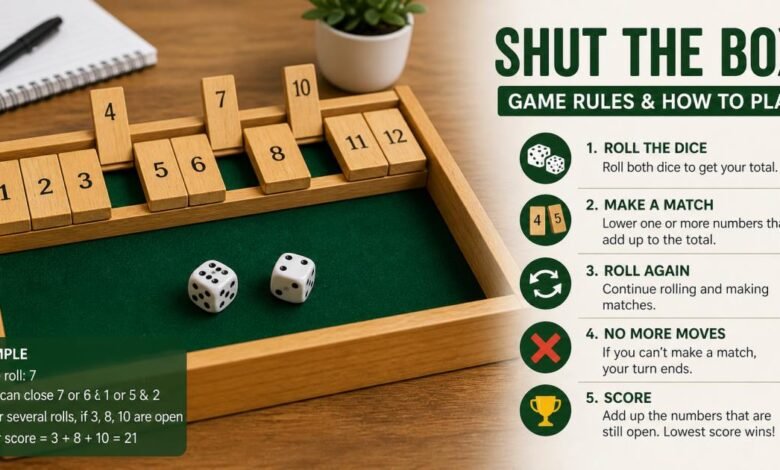
Shut the Box is one of those classic dice games that looks simple at first glance, but quickly turns into a mix of math, luck, and smart decision-making. The goal is easy to understand: close as many numbered tiles as you can, and finish with the lowest score possible. In many versions, if you close every tile, you shut the box and win immediately. That simple idea is a big reason the game has stayed popular for years in homes, classrooms, and casual game nights.
This guide explains the Shut the Box game rules in plain English. You will learn how to set up the game, how each turn works, how scoring works, and what common variations you may see on different boards. You will also get practical strategy tips, pros and cons, and a helpful FAQ at the end.
What Is Shut the Box?
Shut the Box is a dice-and-number game played with a board that has numbered tiles or levers. Traditional versions often use tiles from 1 to 9, while many modern boards use 1 to 12. Players roll dice and close numbers that match the total they rolled. The game is known for being fast, easy to learn, and useful for practicing addition and subtraction.
It is usually played as a turn-based game with one or more players. Some versions are competitive, where the lowest score wins. Others are solitaire-style, where a single player tries to beat a personal best score or clear the board. Because the rules can vary a little by region or board design, it is always smart to check the instructions that come with the set you own.
Why People Still Love the Game
One reason Shut the Box remains popular is that it works well for different ages. Children can use it to practice basic number skills, while adults often enjoy the mix of chance and strategy. The game is also quick, which makes it a strong choice for a short family activity, a classroom warm-up, or a casual gathering.
Another reason people like it is that every turn feels meaningful. Even though the game depends on dice, players still have to choose wisely. That balance between luck and decision-making is a big part of what makes Shut the Box fun to replay.
Shut the Box Game Rules: The Core Idea
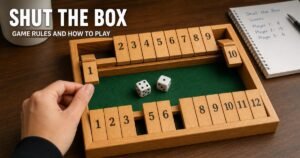
At the heart of the game, the rules are simple. Start with all the tiles open. Roll the dice. Then close one or more open numbers that add up to the total you rolled. Keep rolling and closing numbers until you cannot make a legal move. At that point, your score is the sum of the numbers left open. The player with the lowest score wins, and if someone closes every number, that player shuts the box and wins immediately in many common rule sets.
That sounds easy, but the game becomes more interesting because every choice affects future turns. A move that looks good now may leave you stuck later. A move that preserves flexibility may not close as many tiles right away. That tension is what gives the game its lasting appeal.
What You Need to Play
A standard Shut the Box set usually includes a wooden board with numbered tiles or levers and a pair of dice. Some versions use 1–9 tiles, while others use 1–12. Many 12-tile boards are built to support the same basic gameplay, but with a larger range of numbers.
If you do not have a dedicated board, the game can still be played with simple materials. A paper version, a written number grid, or a classroom-made board can work for practice as long as everyone agrees on the setup and scoring before play begins.
Setup: How to Start the Game
At the start of the game, all numbers are open. On a 9-tile board, the numbers 1 through 9 are visible and available. On a 12-tile board, the numbers 1 through 12 are open. Players then decide who goes first, or they can simply take turns in order.
For many household games, no special setup is needed beyond opening all the tiles and placing the dice nearby. If you are playing competitively, it helps to agree on the scoring method before the first roll so that there is no confusion later.
How a Turn Works
A turn begins with a roll of the dice. In many common versions, players roll two dice at the start. The player then adds the dice together and closes one or more open tiles that match that total. For example, if the roll is 8, legal combinations might include 8 alone, or 7 and 1, or 6 and 2, or 5 and 3, depending on which numbers are still open on the board.
After closing one legal combination, the player rolls again and repeats the process. The turn continues until the player reaches a roll that cannot be matched by any open numbers. At that point, the turn ends, and the remaining open numbers are counted as the score for that round.
The Most Important Rule: You Must Make a Legal Match
The key rule in Shut the Box is that you can only close open tiles whose numbers add up exactly to the dice total. You cannot close random numbers, and you cannot make a move that does not match the roll. If the total cannot be formed using the remaining open tiles, your turn is over.
This is the part that gives the game its challenge. Early in the game, many combinations are possible. Later, when fewer tiles remain, the board becomes harder to manage. Planning ahead matters because some choices leave you with more useful options on future rolls than others.
How Scoring Works
Most commonly, scoring is based on the sum of the numbers left open when a player can no longer move. For example, if 2, 3, and 5 are still open, the score for that turn is 10. After all players take a turn, the lowest score wins. If a player closes every tile, that player wins immediately in the standard version of the game.
Some rule sets use other scoring methods. One common alternative is Missionary, where the score is simply the number of open tiles left. Another variation is Golf, where the score is the sum of all open numbers, which is very close to the standard method most people use. Because different boards and groups may prefer different systems, it is worth agreeing on the scoring style before play starts.
One Die or Two Dice?
Many versions use two dice for most of the game. However, some 12-tile rule sets allow a player to switch to one die when the remaining numbers are low enough that rolling two dice would make the game unwinnable too often. One published rule set says that if the sum of the remaining tiles is 6 or lower, the player may roll one die; otherwise, the player must roll two.
That rule is not universal, though. Other versions keep two dice throughout the game. This is one of the most important differences between boards and rule sheets, so it is best to treat the official instructions in your set as the final word if they differ from another source.
Shut the Box Rules for 9-Tile Boards
The classic 9-tile version is probably the version most people imagine when they hear the name Shut the Box. All numbers from 1 to 9 are open at the start. Players roll dice and close matching combinations until no legal move is available. The final score is the total of the open numbers.
Because there are fewer tiles, the 9-tile version often feels a bit faster and more compact. It is a great choice for younger players or for anyone learning the basic rules for the first time. It also works well as a short game between other activities because rounds are usually quick.
Shut the Box Rules for 12-Tile Boards

The 12-tile version follows the same basic idea, but it gives players more numbers to work with. Standard instructions for 12-tile boards commonly describe the same gameplay as the 9-tile version: roll, match the total, close valid tiles, and score the remaining open numbers. Some 12-tile instructions also add the option to roll one die when the remaining total is 6 or less.
A 12-tile board can make the game feel a little more strategic because there are more possible combinations on each turn. That does not guarantee an easier game, though. More tiles also mean more possible ways to get trapped later.
Examples of Legal Moves
If you roll a total of 9, and the board still has 1, 2, 3, 4, 5, 6, 7, and 8 open, several combinations may be legal. You might close 9, or 8 and 1, or 7 and 2, or 6 and 3, or 5 and 4, or other combinations that total 9, as long as all chosen tiles are still open.
The exact combination you choose is often the most strategic part of the game. Two different moves may both be legal, but one may leave better future options than the other. That is why players often think a little before making their decision instead of choosing the first available combination.
Common Mistakes Beginners Make
A frequent beginner mistake is closing numbers too quickly without thinking about what could happen on the next roll. A move that clears a lot of tiles may feel exciting, but it can leave an awkward combination behind that is hard to match later. Another common mistake is forgetting that numbers must be open and available before they can be closed.
Some players also make the error of thinking they can split a total into any numbers they want. In reality, the total must come from open tiles that match the dice roll exactly. It is not enough for the chosen numbers to add up correctly; they also have to be numbers that are still open on the board.
Best Strategy Tips for Better Scores
A strong Shut the Box strategy usually starts with preserving flexibility. Instead of always removing the largest possible total, try to choose the combination that keeps the most future options open. Often, that means considering not just the current roll, but the shapes of numbers that remain on the board after your move.
Here are a few practical strategy ideas:
- Look for moves that leave balanced numbers behind.
- Avoid blocking too many small combinations early.
- Pay attention to the remaining tile patterns, not just the current score.
- Keep high numbers available when possible, since they can be harder to fit later.
- Treat each roll as part of a longer sequence, not a separate moment.
These are not guaranteed winning tactics, because dice always play a major role. Still, thoughtful choices can improve your odds and help you avoid obvious traps.
Shut the Box as a Learning Game
Shut the Box is often used as a learning tool because it naturally reinforces number recognition, addition, subtraction, and mental math. The game gives players repeated practice in adding dice totals and identifying combinations quickly. That makes it especially useful in home learning and classroom settings.
It also teaches softer skills such as patience, turn-taking, and decision-making under pressure. Because the rules are simple, players can focus on the math and strategy rather than on learning complicated gameplay. That makes it a useful educational board game for mixed-age groups.
How to Play with Kids
For children, the game works best when an adult explains the rules slowly and gives a few example turns before starting real play. Younger players may need help spotting combinations that match the dice total. That is completely normal, and it is part of what makes the game useful as a learning activity.
If the child is new to number games, it may help to start with the 1–9 version rather than the 1–12 version. The smaller range makes the board easier to understand, and the rounds move faster. Once the player becomes comfortable, the 12-tile board can offer a bigger challenge.
Family Game Night Benefits
Shut the Box is a good fit for family game night because it is short, easy to teach, and fun to replay. Unlike longer board games that require a lot of setup, this one can be ready in moments. It also gives every player a clear turn and a clear score, which keeps the game easy to follow.
Another advantage is that people of different ages can play together without the game becoming too complicated. Younger players can focus on finding matches, while older players can think more strategically about future turns. That makes the game flexible for mixed-age groups.
Classroom and Homeschool Use
Teachers and homeschool parents often like Shut the Box because it turns arithmetic practice into a game. Students get repeated exposure to number combinations in a setting that feels playful rather than like a worksheet. This can be especially helpful for learners who do better with hands-on activities.
It can also be used for quick warm-ups, station work, or small-group practice. Because the game is flexible, educators can adapt the pace, the board size, or the scoring method to match the level of the group.
Pros and Cons of Shut the Box
Pros
The biggest strengths of Shut the Box are simplicity, speed, and replay value. It is easy to learn, does not require a long setup, and can be played in a few minutes per round. It also supports math practice in a natural way and works well across different age groups.
Another benefit is flexibility. The game can be played with 9 tiles, 12 tiles, solitaire rules, group rules, or classroom variations. That adaptability helps explain why so many versions of the game have appeared over time.
Cons
One downside is that the rules can differ from one set to another. Some boards use one die in certain situations, some do not; some use 9 tiles, others use 12. This can confuse new players if they assume every version is identical.
Another limitation is that the game depends heavily on dice rolls, so luck can outweigh strategy in a single round. That does not make the game less fun, but it does mean that even strong players cannot control every outcome.
Common Variations You May See
Shut the Box has many local and traditional variations. Some published rule sets describe Golf, where the score is the sum of open numbers, and Missionary, where the score is the count of open tiles. Other versions let players stop after a fixed number of rounds or play until someone reaches a target total.
There are also special variants, such as Thai-style or Jackpot versions, where the player may be required to cover only one tile matching one die, one of the dice, or the sum of the dice, depending on the local rule set. Because these variations change the game significantly, they should be treated as separate formats rather than small rule tweaks.
What Counts as Winning?
In the most common scoring format, the winner is the player with the lowest total of open numbers after all players have taken a turn. If a player closes every tile, that player shuts the box and wins instantly in the standard ruleset.
In some versions, especially those played across multiple rounds, the winner may be the first player to reach a target score or the player with the best cumulative result. Because of that, the exact win condition should be agreed upon before the game begins.
A Simple Step-by-Step Summary
Here is the easiest way to remember the shut the box game rules:
- Open all tiles.
- Roll the dice.
- Close any open numbers that add up to the roll.
- Roll again if a legal move is still possible.
- Stop when no legal move remains.
- Add the open numbers for your score.
- The lowest score wins, and a full clear usually wins immediately.
That is the whole game in its simplest form. Once you understand that loop, the rest is mostly practice and better decision-making.
Is Shut the Box Hard to Learn?
Not at all. The basic rules are easy enough for most people to understand after one example turn. The challenge is not learning what to do; it is learning how to choose the best move when several options are available. That is what gives the game its lasting appeal.
For this reason, Shut the Box is a strong choice for beginners, but it still has enough depth to stay interesting over time. Simple rules and meaningful choices are often the sign of a well-designed game, and this one has remained popular for exactly that reason.
Final Thoughts Before You Play
If you are new to Shut the Box, the most important thing is to agree on the rules before the first roll. Decide whether you are using 9 tiles or 12, whether one die is allowed in certain situations, and how scoring will work. Once everyone understands the setup, the game becomes smooth, fast, and surprisingly engaging.
The beauty of Shut the Box is that it stays simple while still rewarding smart play. That combination makes it a timeless dice game for families, classrooms, and casual game nights.
Conclusion
Shut the Box is easy to learn, quick to play, and full of small decisions that make every round different. The basic shut the box game rules are simple: roll the dice, close matching numbers, keep going until you cannot move, and finish with the lowest score possible. In many versions, closing all the numbers ends the game immediately with a win.
Whether you are playing with kids, using it as a math practice game, or bringing it to family game night, Shut the Box offers a nice balance of luck and strategy. Once you try it a few times, you will start seeing patterns and making better choices on each turn.
FAQ
Q1. What is the main goal of Shut the Box?
The main goal is to close as many numbered tiles as possible and end with the lowest score. In many common versions, closing every tile wins the game immediately.
Q2. How do you score Shut the Box?
Most often, your score is the sum of the open numbers left on the board when you can no longer make a legal move.
Q3. Do you roll one die or two?
Many versions use two dice, but some 12-tile rule sets allow one die when the remaining total is 6 or lower. Always check the rules for your specific board.
Q4. Can you close any numbers you want?
No. The numbers you close must be open numbers that add up exactly to your dice roll.
Q5. Is Shut the Box good for kids?
Yes. It is commonly used to help children practice addition, subtraction, and number recognition in a game format.
Q6. What happens if you close all the numbers?
In the standard version, you shut the box and win immediately.
Q7. Are all Shut the Box games the same?
No. Some use 9 tiles, some use 12, and some use slightly different scoring or dice rules.
Q8. Is there a strategy in the game?
Yes. Even though dice add luck, smart choices can help you leave more useful numbers open for later rolls.