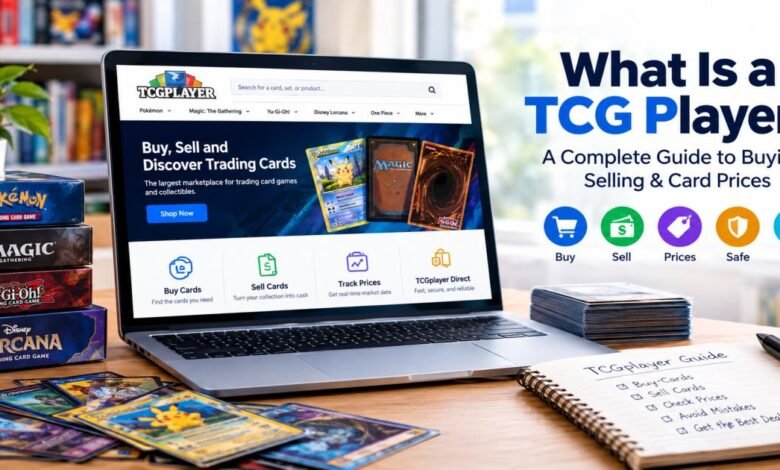
A TCG player is, at its simplest, a person who plays trading card games like Magic: The Gathering, Pokémon, or Yu-Gi-Oh!. But if you searched “TCG player,” there’s a good chance you meant something more specific: TCGplayer, the website where TCG players actually buy cards, sell cards, and check what those cards are worth.
This guide covers that second meaning in full. You’ll learn how the TCGplayer marketplace works, what it costs to sell there, how card pricing is calculated, and whether it’s the right fit for your collection or your business.
What Is TCGplayer?
TCGplayer is an online marketplace built for trading card games. Rather than one company selling cards directly, it connects thousands of independent sellers local game shops, small resellers, individual collectors with buyers hunting for a specific card.
The catalog spans:
- Magic: The Gathering
- Pokémon
- Yu-Gi-Oh!
- One Piece Card Game
- Disney Lorcana
- Star Wars Unlimited
- Digimon Card Game
- Flesh and Blood
- Cardfight!! Vanguard
TCGplayer opened in 2008 in Syracuse, New York, under the original name TradeMatches. It grew into one of the largest card marketplaces anywhere, and in 2022, eBay acquired the company as part of a broader push into trading cards and collectibles. TCGplayer now runs as an eBay subsidiary, headquartered in Louisville, Kentucky.
So what does a TCG player actually use it for? One thing, mostly: finding the exact card, in the exact condition, at a price you can compare across dozens of sellers on a single page.
How Does TCGplayer Work?
Think of TCGplayer as eBay narrowed down to one category: trading cards with every listing tied to a specific card, its set, its condition, and sometimes its language or foiling.
The flow looks like this:
- A seller creates a listing for a card, setting its price, condition, and quantity.
- A buyer searches by card name, set, or game.
- The product page shows every seller’s listing for that card, sorted by price, condition, and shipping.
- The buyer selects one or several listings and checks out.
- The seller ships the card, unless the order qualifies for TCGplayer Direct a fulfillment program covered in detail below.
Because so many sellers list the same card, a single popular one might show dozens of listings, from heavily played copies for a dollar to pristine, sealed copies for far more. That competition is what keeps prices grounded in what buyers will actually pay, not just what one seller hopes to get.
What Can You Buy on TCGplayer?
TCGplayer isn’t limited to loose singles. A typical shopper can find:
- Single cards — the most common purchase, searchable by exact name, set, and condition
- Sealed booster packs and boxes — unopened product straight from a distributor or seller
- Starter decks and structure decks — pre-built decks aimed at new players
- Supplies — sleeves, deck boxes, playmats, storage binders
- Graded cards — professionally graded singles from services like PSA or Beckett, usually listed separately from raw cards
Because every listing is tied to a specific set and printing, a card that’s been reprinted many times, common in both Magic and Pokémon, can be filtered down to the exact version you want instead of a generic mix of copies.
How TCGplayer Card Prices Work
TCGplayer doesn’t show one price per card. It shows several, and knowing the difference is the single most useful thing a buyer or seller can learn on this site.
The main price points on a product page:
- Market Price — an estimate of a card’s real value, built from actual recent sales rather than what sellers are asking
- Listed Median — the middle price among current listings
- Low Price — the cheapest listing currently available
- Most Recent Sale — the price of the last completed transaction for that card and condition
Why does Market Price get the most trust? Because it’s built from what buyers actually paid, not what sellers hoped to get. TCGplayer’s own documentation describes it as using the value a card has recently sold for, rather than relying only on current asking prices. A seller can list a card at $50, but if buyers keep paying $30 for it, Market Price reflects $30, not the seller’s wish.
Market Price also splits by condition and printing, so a Near Mint foil and a Lightly Played non-foil of the same card carry different Market Prices, even though they’re technically the same card. It’s calculated per card, per condition, per treatment, using a rolling average weighted toward recent sales, which is why a card’s price can move fast when buying activity picks up or cools off.
Is Listed Median trustworthy on its own? Not always. On older or lower-volume cards, if only a handful of sellers list a card and they’re all pricing optimistically, Listed Median can sit well above what anyone’s actually paying. That gap is exactly why Market Price exists as a separate, sales-based number instead of just averaging what’s listed.
How to Check a Card’s Value on TCGplayer
Checking what a card is worth takes a few steps:
- Search the card by name on TCGplayer.com.
- Select the correct game, set, and printing (the same card name can appear across multiple sets with very different values).
- Review Market Price, Low Price, and Listed Median on the product page.
- Filter by condition: Near Mint, Lightly Played, Moderately Played, Heavily Played, Damaged to see how the number shifts.
- Check the Market Price Volatility indicator to see how stable that price has been over the last 30 days.
That volatility scale is one of the more useful, less-talked-about features on the site. A card marked “Low Volatility” has held a steady price, so the number is safe to trust. “High Volatility” means the price has swung meaningfully over the past month, so today’s number might look different next week. Cards without enough recent sales get marked “Indeterminate,” TCGplayer’s way of saying there isn’t enough data yet to trust the figure.
Collectors valuing an entire binder or box can skip manual lookups entirely: TCGplayer’s free mobile app scans cards and pulls up pricing instantly, which is considerably faster than searching each card by hand.
How to Buy Cards on TCGplayer
Buying is simple, but a few habits separate a good purchase from a disappointing one.
- Search for the specific card and set. Don’t grab the first result if a card has multiple printings; price and condition standards vary between them.
- Filter by condition. Decide upfront whether you need a display-quality copy or a playable one. Heavily Played copies often cost a fraction of Near Mint.
- Compare total cost, not just card price. Shipping varies by seller, and buying from several sellers means paying shipping more than once.
- Check seller ratings. Every seller carries a feedback score and rating history, visible right on the listing, much like eBay.
- Use the cart optimizer. TCGplayer’s cart tool can consolidate a multi-card order into fewer packages from fewer sellers, often cutting total shipping cost.
- Watch for the Direct badge. Cards fulfilled through TCGplayer Direct ship from TCGplayer’s own warehouse, which many buyers prefer for consistency and faster handling.
What Is TCGplayer Direct?
TCGplayer Direct is a fulfillment program that changes who ships the card to the buyer. Instead of every seller packing and mailing their own orders, Direct-eligible sellers ship inventory to TCGplayer’s Authentication Center ahead of time.
How does the Direct cycle actually work? Based on TCGplayer’s own seller documentation:
- A seller lists cards on the marketplace as usual.
- When an order comes in for a card TCGplayer already holds in Direct inventory, TCGplayer ships it from its own stock on the seller’s behalf.
- TCGplayer sends the seller a summary of what sold.
- The seller ships replacement copies back to TCGplayer, replenishing Direct inventory.
- TCGplayer handles customer service, refunds, and shipping issues on that order, not the seller.
Buyers can spot Direct orders easily: listings carry a “Direct Qualified Seller” badge, and any qualifying order appears in the first package position of the cart with a blue border.
For sellers, Direct is a real trade-off, not a free upgrade. On the upside, Direct-fulfilled cards get featured visibility on the marketplace, and buyer support is handled automatically. On the downside, joining requires meeting a minimum inventory threshold; TCGplayer’s help documentation lists roughly 3,000 unique Direct-eligible products,s plus an added per-item Direct Fee on top of standard commission.
Here’s the detail that trips up a lot of sellers: as of the June 2026 fee overhaul, that Direct Fee runs 50% of a card’s value for anything priced at $2.49 or below, or a flat $1.12 per card above that, on top of standard commission and transaction fees. In plain terms, a budget card sold through Direct effectively loses half its sale price to that one fee alone. That’s exactly why most experienced Direct sellers reserve Direct listings for mid-to-high-value inventory and keep bulk commons on standard Marketplace listings instead.
How to Sell Cards on TCGplayer
Selling takes more setup than buying, but it’s manageable for someone starting small.
- Create a Seller Portal account, separate from a regular buyer account.
- Choose a seller level. New sellers start at Level 1, with listing limits that rise as they complete more orders with good feedback.
- List your first cards’ condition, price, and quantity for each.
- Decide on a pricing strategy. Many new sellers rely on TCGplayer’s automated pricing tools, which track Market Price and Low Price instead of manual updates.
- Fulfill orders promptly. Shipping speed directly affects seller ratings.
- Build toward Level 4 if higher-volume selling or the Direct program interests you. u Direct requires Level 4 status.
How long does that take? New sellers are typically capped around 100 active listings until they build a track record. Reaching Level 4, which removes that cap, generally requires around 51 completed orders and a feedback rating of at least 90%, according to seller guides referencing TCGplayer’s published criteria. Most sellers hit that mark within a few weeks to a few months, depending on listing volume and shipping speed.
TCGplayer Fees Explained
Fees are the part most new sellers underestimate, te and TCGplayer changed its fee structure twice in 2026, so precision matters here.
Standard Marketplace Sellers (Level 1 through 4) pay a 10.75% commission per sale, up from 10.25% as of February 10, 2026. Every seller, regardless of level, also pays a transaction fee of 2.5% plus $0.30, charged on the full order total, including items, shipping, and any collected sales tax, not just the card price.
Sellers who upgrade to Pro Seller status pay a lower 9.25% commission plus a separate 2.5% Pro Fee, plus the same transaction fee. That lower commission is why many higher-volume sellers eventually upgrade; the subscription tends to pay for itself once monthly sales reach a few hundred dollars.
Commission is capped at $75 per item, which matters if you’re selling genuinely expensive singles or sealed product.
Then there’s Direct. The per-item Direct Fee is 50% of value under $2.49, or a flat $1.12 above that, replacing the older, more complicated Shipping Replacement Cost tiers in June 2026. TCGplayer’s own published analysis of that change reported that over 95% of Direct sellers were expected to see lower total fees under the new item-based structure than under the old one. For sellers weighing whether Direct is worth it, that June 2026 change is the number to check first, since it directly determines whether Direct helps or hurts your margin on lower-value cards.
International sellers carry one more line item: a 3.5% + $0.30 transaction fee on international orders, plus a 2% PayPal processing fee (capped at $20) for anyone paid that way.
Add it up, and a typical Marketplace Seller loses roughly 13% to 14% of an order’s total value to combined commission and transaction fees a figure worth building into pricing from day one, not discovering after the first payout.
How to Price Cards for Sale on TCGplayer
Price too high and a card sits unsold. Price too low and you leave money on the table. A few practical rules help:
- Start near Market Price, not Listed Median. Market Price reflects what buyers actually pay; Listed Median can be inflated by optimistic sellers.
- Undercut slightly for faster sales. Pricing a few cents below the current Low Price is a common tactic for moving commons and bulk cards quickly.
- Factor in fees before setting a price. With commission and transaction fees eating roughly 13–14% of a sale, build that margin in from the start.
- Account for shipping on Direct listings. Direct-fulfilled cards don’t carry a separate shipping charge, so most Direct sellers fold shipping cost into the card price itself.
- Re-check pricing regularly. Market Price moves with a rolling average of recent sales, so a price that was competitive last month may be off today, especially on cards flagged as high volatility.
- Use the Price Differential Report. TCGplayer’s Seller Portal includes a built-in tool comparing your listings against Lowest Listing and Market Price, making it easy to spot prices that have drifted.
Is TCGplayer Safe and Legit?
Yes, TCGplayer is a legitimate, established marketplace, not a scam. It’s been running since 200; it’s owned by eBay, a well-known public company, and it processes a large volume of transactions daily across thousands of independent sellers.
That said, is every experience on TCGplayer guaranteed to be smooth? No, and it helps to know where the friction tends to show up:
- Seller quality varies, since anyone meeting basic requirements can open a seller account. Checking a seller’s rating before buying from someone unfamiliar is a reasonable habit.
- Customer service response times have drawn criticism. Public reviews on sites like Trustpilot describe slow support responses and account issues taking longer than buyers expected to resolve.
- Direct-fulfilled orders reduce that risk, since TCGplayer itself, not an individual seller, handles shipping, packaging, and disputes on those specific orders.
- Direct inventory goes through TCGplayer’s own Authentication Center, adding a layer of condition verification that doesn’t exist on standard seller-to-buyer shipments.
The honest read: TCGplayer as a company is legitimate and well-established, but individual seller experiences can vary, which is true of essentially any large third-party marketplace, from eBay to Amazon’s own marketplace sellers.
TCGplayer for Beginners: Common Mistakes to Avoid
New TCG players and new sellers tend to hit the same handful of avoidable problems:
- Buying the wrong printing. Searching by card name alone, without checking set and edition, is the most common buying mistake; the same name can exist across a dozen sets with very different values.
- Ignoring condition grades. “Lightly Played” is not “Near Mint,” and the price gap reflects that. Read condition descriptions closely on higher-value cards.
- Underpricing when selling. New sellers sometimes price straight off Listed Median without checking Market Price first, which can mean selling well under actual value.
- Forgetting fees when pricing. Listing a card at exactly what you want to earn, without accounting for the roughly 13–14% combined commission and transaction fee, is a fast way to lose money on every sale.
- Splitting orders across too many sellers. Buying five cards from five sellers means five separate shipping charges unless the cart optimizer consolidates them.
- Skipping seller feedback checks before ordering from someone new, especially for higher-value singles.
TCGplayer vs. Other Online Card Marketplaces
Is TCGplayer the only option for buying and selling cards online? No, here’s how it compares to the most common alternatives:
| Feature | TCGplayer | eBay | Local Game Store Sites |
| Focus | Trading cards only | General marketplace | Varies by store |
| Price transparency | Market Price, Low, Median all visible | Based on completed listings, less standardized | Often fixed, less negotiable |
| Seller variety | Thousands of specialized sellers | Millions of general sellers | Single store inventory |
| Fulfillment options | Seller-shipped or TCGplayer Direct | Seller-shipped only | Store-shipped or in-person |
| Typical seller fees | ~10.75% commission + transaction fee | ~13.25% for most categories | Varies, often built into price |
| Buyer protection | Marketplace policies + Direct program | eBay Money Back Guarantee | Store-specific policies |
| Best for | Comparing prices across many sellers for one card | Rare, one-off, or collector-grade items | Building a relationship with a trusted local shop |
The practical difference comes down to specialization. TCGplayer’s search filters, condition standards, and pricing data are all built around trading cards specifically, which makes finding an exact card faster than searching a general marketplace like eBay. eBay, in turn, can be the better fit for rare, graded, or one-of-a-kind pieces where auction-style bidding might land a better price than a fixed listing.
Is TCGplayer Worth Using?
For most people who play or collect trading card games, yes. Price transparency, a large seller base, and specific search filters solve a real problem: finding the exact card you want at a fair, checkable price.
It’s most worth using if you:
- Play a widely supported game like Magic, Pokémon, or Yu-Gi-Oh!
- Want to compare prices across many sellers before buying
- Are looking to turn a card collection into income, even part-time
- Want to check a card’s real market value before a trade or sale
It may be less ideal if you:
- Only care about a handful of extremely rare or graded cards, where eBay’s auction format might work better
- Prefer buying exclusively in person from a local store
- Sell in very low volume and don’t want to deal with seller fees at all
Final Verdict
TCGplayer earns its place as one of the most useful tools any TCG player can use, whether you’re buying one card for a deck or building a side business out of a bulk collection. Its real strength is transparency: Market Price, Low Price, and Listed Median together give a clearer read on a card’s actual value than most marketplaces offer.
The trade-off is complexity. Between seller levels, commission tiers, and the Direct program’s fee structure, reshaped as recently as June 2026, getting the most out of TCGplayer as a seller takes a bit of a learning curve. But for straightforward buying searching for a card, comparing sellers, checking a fair price it remains one of the simplest, most reliable places online to do exactly that.
FAQs
What is TCGplayer?
TCGplayer is an online marketplace where independent sellers list trading cards, sealed products, and supplies for games like Magic: The Gathering, Pokémon, and Yu-Gi-Oh!. It’s owned by eBay and has operated since 2008.
Is TCGplayer legitimate?
Yes. TCGplayer is a legitimate, long-running company owned by eBay, processing large volumes of transactions daily. Individual seller experiences can still vary, so checking seller ratings before buying is worth the extra minute.
How accurate are TCGplayer prices?
Market Price is generally the most accurate figure, since it’s based on actual completed sales rather than what sellers are asking. Listed Median can be less reliable on rare or low-volume cards, where only a few optimistic listings exist.
How does TCGplayer Market Price work?
Market Price is a rolling, weighted average of recent completed sales for a specific card, condition, and printing. Recent sales carry more weight than older ones, and the price won’t shift if no new sales occur, so a stale Market Price can lag behind current demand.
Can you sell Pokémon cards on TCGplayer?
Yes. Pokémon is one of the core supported games on TCGplayer, alongside Magic: The Gathering and Yu-Gi-Oh!, and it’s eligible for the TCGplayer Direct fulfillment program.
How much does TCGplayer charge sellers?
Standard Marketplace Sellers pay a 10.75% commission plus a 2.5% + $0.30 transaction fee per order. Pro Sellers pay a reduced 9.25% commission plus a separate 2.5% Pro Fee. Direct sellers pay an additional per-item Direct Fee on top of standard commission introduced in its current form as part of the June 2026 fee restructuring.
Does TCGplayer ship internationally?
Yes, though individual sellers choose whether to enable international shipping on their own listings. International orders carry a higher 3.5% + $0.30 transaction fee, and international sellers paid via PayPal face an added 2% processing fee, capped at $20.