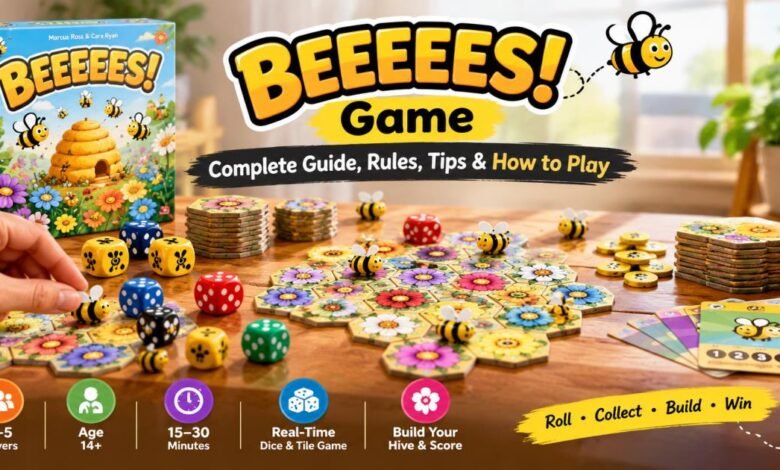
Beeeees game puts 2 to 5 players in a real-time race to claim flower tiles with dice and build the strongest honeycomb hive. Everyone rolls at once, fights over neighboring stacks, and scores by connecting matching colors. The player who has the best hive wins. This guide walks through every part of the game so you can sit down and play with confidence.
What Is Beeeees Game?
Beeeees game is a real-time dice and tile game first released in 2017. Players act as young queens competing to impress the High Queen by building the finest hive in the meadow. You roll five special dice as fast as you can, match the results to open flower tiles, and claim those tiles for your personal hive.
The game runs on simultaneous play. No one waits for a turn. You shake dice between both hands, drop them, and place matching results on the tiles in front of you or the two neighbors beside you. The person who covers the most spaces on a finished flower takes the tile, flips it to the honeycomb side, and adds it to their growing hive. Matching colors that touch each other earn the bulk of the points at the end.
Speed matters, yet smart placement matters more. Grabbing every tile without thinking about color groups often loses to a tighter, better-connected hive. Worker Bee faces act as wilds. Two or more stinger faces let you shout “Killer Bees!” and take a tile immediately.. Special wildflowers start short Beeline races where players race to roll the numbers 1 through 5 in order.
Most sessions finish in 15 to 30 minutes. The mix of frantic rolling and careful hive building keeps the table loud and focused the whole time.
Beeeees Game at a Glance
- Number of players: 2–5
- Recommended age: 14 and up (many groups include younger players who handle the pace)
- Average playing time: 15–30 minutes
- Game type: Real-time dice rolling plus tile placement
- Main mechanics: Simultaneous rolls, majority claiming, color matching, adjacency placement
Player interaction stays high because everyone reaches into the same three stacks. A tile you almost finished can vanish under a neighbor’s dice in seconds.
What You Need to Play Beeeees Game
Open the box and you find:
- Five dice for each player (faces show 1–5 plus Worker Bee wilds and Killer Bee stingers)
- Hexagonal flower/hive tiles sorted into lettered stacks (roughly 16 tiles per player)
- Soft rubber Helper Bee tokens
- One Beeline card per player
- A simple score track or pad
Each player needs space to reach their own tile stack plus the stacks of the people sitting left and right. A flat table works best. Keep the Helper Bee supply in the middle where everyone can grab them.
Final Verdict: Is Beeeees Game Worth Playing?
Beeeees game delivers loud, fast table energy mixed with a clear scoring puzzle. Groups that enjoy active, interactive sessions and short playtimes get the most from it. Families and casual circles usually keep it in regular rotation. Players who strongly prefer quiet, sequential turns may find the pace tiring. The combination of simultaneous rolling, shared stacks, and color-connection scoring gives it a distinct feel among real-time dice games. If your table likes a bit of chaos and a clear winner after half an hour, this title earns its place on the shelf.
Separate the tiles into their lettered groups. Each player takes one stack, shuffles it, and keeps the flower side up. Hand out matching dice sets and Beeline cards. Place the Helper Bees in a central pile—typically six tokens for each player at the table.
Sit so every person can easily touch three stacks. Hold your stack and dice. Count down together—3, 2, 1—then set the stacks down and start rolling. Before the first shake, confirm that dice must stay between both hands and that unused dice return for the next roll. No one may set dice aside.
How to Play Beeeees Game: Step-by-Step
Everyone acts at the same time. The real-time dice race never pauses.
Start the Real-Time Dice Race
Shake all free dice between both hands and drop them. Scan the open flowers on your three reachable stacks.
Roll and Place Your Dice
Match the numbers or groups printed on the flower tiles. Single spots take one matching die. Grouped spots need the full set from the same roll. Worker Bees count as any number. Once a die sits on a tile it stays there until the flower finishes or leaves the table.
Claim Flower Tiles
When every space on a flower is covered, the player with the most dice on it claims the tile. Flip it to the honeycomb side and place it in your hive. Anyone who contributed fewer dice takes a Helper Bee.
Compete for Tiles on Neighboring Stacks
You may place dice on your stack and the two next to you. Neighbors may place on yours. This overlap creates constant pressure. A flower that looks safe can disappear in a single good roll from the side.
Use Worker Bees and Killer Bees
Worker Bees give flexible placement. Two or more stingers in one roll let you call “Killer Bees!” Take the top tile from any stack that you can reach immediately. No Helper Bee is awarded on a Killer Bee steal.
Build Your Hive
The first honeycomb tile goes anywhere. The second must touch the first. Every tile after that must touch at least two existing tiles. Place with color groups in mind—matching edges score the points that decide the winner.
Handle Wildflowers and Beeline Races
A wildflower, typically in multiple colors or white, triggers a Beeline. Any player who has all five dice free may call “Beeline!”Players must race to arrange the dice in order from 1 to 5 on their cards. Worker Bees help. Stingers do not. The first player to finish the sequence claims the wildflower.
Play keeps moving until the end conditions hit.
Beeeees Game Rules You Need to Know
Dice placement follows strict limits. You roll every free die together. You may only touch the three stacks within reach. Placed dice stay until the tile resolves. Majority decides ownership. Three players each putting one die can cause a Buzzkill—the tile leaves the game. Helper Bees go only to minority contributors. Killer Bees allow instant steals. Hive tiles must follow the adjacency rule. Wildflowers start sequential Beeline races. Empty stacks do not expand your reach to farther tiles.
These limits keep the chaos fair and give every decision weight.
How Scoring Works in Beeeees Game
After the last tile is claimed, count your hive:
- Score 1 point for every edge where two same-color honeycomb tiles touch.
- Wildflowers count as every color, so they boost multiple edges at once.
- Helper Bees score 1 point for every pair you hold.
- The player with the most Helper Bees earns the “Bee’s Knees” title and a 3-point bonus.
A typical winning score sits between 15 and 30 points depending on player count and how tightly colors group. Focus on large matching clusters rather than the highest number of tiles.
How Does Beeeees Game End?
The game stops when the Helper Bee supply runs out or when a set number of flower stacks empty (most groups use three stacks). Finish any open claims, then score every hive. Highest total wins.
Best Beeeees Game Tips & Strategies
Keep your eyes on the neighboring stacks while you roll. Pure speed without watching the table loses tiles. Leave some dice free so you can jump into a Beeline or cover a sudden opening. Build around two or three colors instead of scattering across every shade. Place Helper Bees opportunities on purpose—dropping one die on a nearly finished flower often earns a token while an opponent claims the tile. Use Killer Bees to snatch tiles that complete strong color groups for rivals. Track the colors already sitting in each neighbor’s hive so you know which flowers hurt them most. Leave open spots in your own hive that future matching tiles can fill.
Common Mistakes New Players Make
New players often stare only at their own stack and miss easy claims next door. They lock every die on one flower and then sit idle while better options appear. Many place the first few tiles without a color plan and end up with a scattered hive that scores poorly. Others chase every wildflower and ignore the steady points from regular tiles and Helper Bees. Speed alone rarely beats a player who balances pace with color connections.
Is Beeeees Game Good for Beginners?
The basic loop—roll, match, claim—is clear after one round. Real-time pressure and the adjacency rule add the challenge. Most groups teach the game in under five minutes and play a full round right away. Players who like energetic table talk and quick decisions pick it up fast. Those who prefer quiet, turn-based games may need a couple of sessions to settle into the pace.
Is Beeeees Game Better With 2, 3, 4, or 5 Players?
Two players create a direct duel over the shared stacks. Three works smoothly. Groups typically enjoy an increase in noise and overlapping claims. Higher counts increase the chance that a neighbor will snatch a tile you wanted, and that tension drives the fun. Choose the count that matches the energy level of your table.
Pros and Cons of Beeeees Game
Pros
- Fast sessions that fit between longer games
- Clear core idea with room for skill
- High interaction through shared stacks
- Satisfying color-matching puzzle at the end
Cons
- Real-time pace can feel intense
- Dexterity and reaction speed matter
- Less appealing to players who want strict turns
Beeeees Game vs. Other Real-Time Dice Games
Many real-time dice titles focus only on pure speed. Beeeees game adds a lasting placement puzzle. You still race, yet the final score depends on how the claimed tiles connect by color. The neighboring-stack rule and Killer Bee steals create social friction that pure rolling games often lack. Players who want short, loud sessions with a clear strategic finish tend to prefer this mix.
Final Verdict: Is Beeeees Game Worth Playing?
Beeeees game delivers loud, fast table energy mixed with a clear scoring puzzle. Groups that enjoy active, interactive sessions and short playtimes get the most from it. Families and casual circles usually keep it in regular rotation. Players who strongly prefer quiet, sequential turns may find the pace tiring. The combination of simultaneous rolling, shared stacks, and color-connection scoring gives it a distinct feel among real-time dice games. If your table likes a bit of chaos and a clear winner after half an hour, this title earns its place on the shelf.
Frequently Asked Questions About Beeeees Game
What is Beeeees Game?
A real-time dice-rolling and hive-building board game for 2–5 players where matching colors and quick claims decide the winner.
How many players can play Beeeees Game?
Two to five players.
How long does Beeeees Game take?
Most games finish in 15 to 30 minutes.
What age is Beeeees Game for?
The box lists 14 and up.Groups that focus on younger players often include them in their activities.
Is Beeeees Game easy to learn?
Yes. The basic actions become clear after a single short round.
How do you win Beeeees Game?
Build the highest-scoring hive through matching color edges, Helper Bee pairs, and the Bee’s Knees bonus.
What are Killer Bees and Worker Bees?
Worker Bees are wild faces that count as any number. Killer Bees (two or more stingers) let you steal a tile immediately.
What is a Beeline in Beeeees Game?
A short race triggered by a wildflower. Players with free dice try to place the numbers 1 through 5 in order.