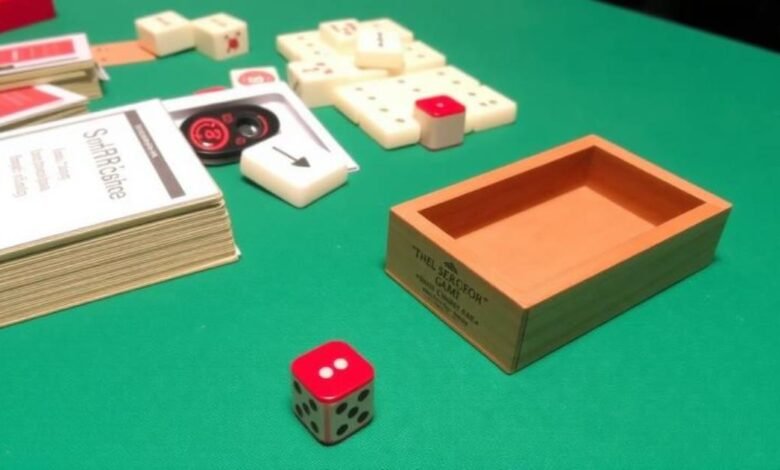
The shut the box game is one of those rare tabletop games that feels simple the first time you see it and still stays interesting after many plays. You roll dice, close numbered tiles, and try to keep your options open long enough to get the lowest score or shut every number and win outright. It is a quick game, but it also rewards smart choices, basic math, and a little nerve. That is part of why it has stayed popular as a pub game, a family game, and even a classroom-friendly math activity.
What makes the game especially appealing is that it works in more than one setting. People play it solo, with a couple of friends, or in a larger group. Traditional versions use a wooden box with hinged or sliding number tiles, but the game can also be played with simple dice and numbered cards or paper. That flexibility helps explain why the shut the box game still shows up in homes, game rooms, and casual gatherings today.
What Is the Shut the Box Game?
The shut the box game is a dice-based number game in which players try to cover, close, or “shut” numbered tiles by matching them to the total of the dice roll. In the classic version, the box contains numbers 1 through 9, though some sets use 10 or 12 tiles. A turn continues until the player can no longer make a valid combination from the remaining open numbers. At that point, the remaining uncovered numbers become the player’s score. If a player closes every tile, that player has shut the box and wins immediately in many rule sets.
At first glance, the game looks like pure luck because dice control the flow. But the real tension comes from decision-making. After each roll, there may be several possible combinations that add up to the same total, and the choice you make can shape the rest of the round. That is why many players think of it as a mix of arithmetic, probability, and risk management rather than a game of chance alone.
Why the Shut the Box Game Still Works So Well

There are plenty of old games that feel dated, but the Shut the Box game still feels fresh because it hits several strengths at once. It is fast, easy to teach, satisfying to play, and adaptable for different ages and group sizes. It also gives players an immediate goal: every roll matters, and every closed tile feels like real progress.
Another reason it stays relevant is that the game is highly portable. A classic set is small enough to sit on a coffee table, and the rules do not require cards, a board, or a complicated setup. That makes it a strong choice for family game night, travel, casual entertainment, and even a quick break between other activities.
The History of Shut the Box
The exact origin of the shut the box game is not settled. Traditional game references say the game is most often linked to northern France, especially Normandy, or the Channel Islands. Those same sources also note that it has likely been played in that region for at least two centuries, while evidence of the game in England appears much later, around the middle of the 20th century.
That uncertain history is part of the game’s charm. Some accounts connect it to sailors, fishermen, and pub culture, which fits the simple, rugged design of the game very well. Museum records also describe the shut the box sets as wooden game equipment with tiles and dice, reinforcing the idea that this was a practical social game rather than a formal tournament-style pastime.
One important point for readers is that there is no single worldwide governing body for the shut the box game. Different regions and communities developed their own habits, so you will see variations in scoring, tile count, and turn structure. In other words, the “correct” rules often depend on the version people around you already know.
How to Play the Shut the Box Game
The Basic Equipment
The classic shut the box game uses an open wooden tray with numbered tiles, usually 1 through 9, along with two dice. Each number has a cover or flap that can be flipped shut. Some sets use a dice cup, but that is optional. More elaborate versions may include 10 or 12 tiles, or even multiple players using separate sections of the box.
The Goal of the Game
The goal is simple: shut as many numbers as possible. In many rule sets, if you manage to close every number, you win immediately. If not, the player with the lowest remaining total at the end of the round wins. That makes the game feel competitive even when every player takes only one turn per round.
The Turn Structure
A turn begins with a dice roll. The player adds the dice total and then closes any valid combination of open numbers that equals that total. The player keeps rolling and closing numbers until no legal move remains. Once a roll cannot be matched by the open tiles, the turn ends, and the player’s score is the sum of the numbers still uncovered.
A classic example helps make this clear. If the dice total is 8, the player may be able to shut 8, or 7 and 1, or 6 and 2, or 5 and 3, or 5, 2, and 1, or 4, 3, and 1, depending on which tiles are still open. The best choice is not always the most obvious one, because preserving useful combinations for later rolls can matter just as much as closing the largest tile right away.
When You Use One Die or Two Dice
In many common rules, you must use both dice as long as 7, 8, and 9 are still open. Once those higher numbers are all shut, you may choose to roll one die or two. That rule matters because it changes the range of possible totals and affects your odds as the game narrows.
Step-by-Step Rules in Plain English
1. Start with all tiles open
Every tile begins uncovered. In the most familiar setup, that means numbers 1 through 9 are open and ready to be used.
2. Roll the dice
The player rolls the dice and adds the pips together. The total determines which numbers may be closed.
3. Choose a valid combination
The player must shut numbers that add up exactly to the roll. If there are several valid combinations, the player chooses one. If there is no valid combination left, the turn ends.
4. Keep going while legal moves exist
If the chosen combination is available, the player closes those tiles and rolls again. A good turn can produce a long chain of successful closes, which is part of what makes the game exciting.
5. Score the remaining open numbers
When no legal move remains, the player adds up the numbers still open. That total is the score for the round. In many versions, the lowest score wins unless someone shuts the box entirely, in which case the game ends instantly with that player as the winner.
Common Shut the Box Variations
One reason the shut the box game remains lively is that there are many local and traditional rule variations. Since there is no global authority setting a single official standard, the game often changes from one household, pub, or region to another.
Classic 9-Tile Version
This is the version most people recognise first. It uses numbers 1 through 9 and two dice. It is compact, easy to teach, and widely played in casual settings.
10- or 12-Tile Versions
Some sets use 10 or 12 tiles instead of 9. Larger sets can create longer rounds and more combination possibilities, which is useful if you want a game that feels a little less predictable.
Solo Play
Some people play Shut the Box alone as a quiet pastime. In that format, the challenge is often to beat your own score or shut the box with greater consistency over time.
Group and Pub Play
Traditional pub play often involves staking a pool at the start and awarding the pool to the winner at the end of the round. That gambling format is part of the game’s historical identity, although modern families often play it with no money at all.
2-Player or Multi-Player Boards
Some commercial sets are made for two, four, or even six players. In those versions, players may take turns on a shared board or use separate dice areas depending on the set design and local rules.
Best Strategy for the Shut the Box Game
The shut the box game is easy to learn but not as random as it first looks. Because the available combinations change with every roll, the player has to think about both the immediate move and the numbers that will remain for the next turn. That is why many players describe it as a probability game with a strong arithmetic element.
Protect Future Options
A common beginner mistake is to shut the largest number whenever possible without considering the rest of the board. That can feel safe, but it may leave you with awkward leftover combinations later. A stronger approach is to look at which tiles will remain after the move and ask, Will this leave me with more ways to continue? This is an inference from the game’s rules and is one of the main skills that separates casual play from smarter play.
Think About Small Numbers
As the board clears, small numbers become especially important. Moves that preserve flexible combinations with 1, 2, 3, and 4 often help you avoid getting stuck too early. Because you need exact totals, the shape of the remaining board matters just as much as the total sum of open tiles.
Do Not Rush the First Few Rolls
Early in the game, many totals can be formed in several ways. That means the first few decisions are often about keeping the board balanced rather than forcing the biggest possible close every time. Players who stay flexible early tend to have better later options. This is an inference from the game’s combination structure and the probability-focused nature of play.
Choose a Strategy and Stay Consistent
Some players prefer to shut the highest tile available whenever possible. Others prefer to break large totals into smaller pieces when that preserves future options. There is no single rule that guarantees success in every position, but consistency helps. The game rewards people who learn their preferred pattern and notice how different openings affect later rolls.
Why the Game Is Great for Families and Casual Play
The shut the box game works well for families because it is easy to explain without sounding childish. Adults can enjoy the quick decision-making, while younger players can practice addition in a playful setting. That balance makes the game useful in homes looking for a simple, screen-free option that still feels competitive.
It is also a strong choice for family game night because the rounds are short. No one has to wait a long time for a turn, and every player gets a clear chance to do better than the last round. That makes it a good fit for mixed-age groups, relaxed evenings, and casual hosting.
Educational Value of Shut the Box
Even though it is fun first, the shut the box game naturally supports basic math practice. Players constantly add dice totals, compare combinations, and think about number relationships. That makes the game useful as an educational math game, especially for children who learn best through hands-on play.
It can also support probability awareness. Players quickly notice that some totals are more common than others and that some board positions are easier to escape than others. This is one reason the game has attracted both casual players and people interested in game theory or probability analysis.
Pros and Cons of the Shut the Box Game
Pros
The biggest advantage of the shut the box game is its simplicity. The rules are easy to learn, the setup is fast, and the gameplay is immediate. It also works for solo sessions, small groups, and larger gatherings, which makes it a flexible indoor game.
Another plus is that it feels satisfying. Closing tiles gives players a clear sense of progress, and a near-complete board creates real tension. That one more roll feeling is a big reason the game remains appealing across generations.
Cons
The game can feel repetitive if a group wants long, story-driven play. Some players may also find the outcome too dependent on dice luck when they are in a bad position. Finally, because local rules vary, people sometimes need a minute to agree on how their version works before starting.
How to Choose a Shut the Box Set
If you are shopping for a wooden shut the box game, the main things to look for are build quality, number clarity, and tile design. Smooth hinges or flaps, easy-to-read numbers, and sturdy construction matter more than flashy extras. A good set should feel comfortable to use and durable enough for repeated play.
For most households, a standard 9-tile set is enough. It is compact, familiar, and easy to store. If you want a little more variety, a 10- or 12-tile version may be a better fit because it offers more combinations and a longer game.
You may also want to think about your audience. A family with younger children may prefer a simple board that is easy to reset. Adults looking for a stylish tabletop piece may prefer a heavier wooden version that looks good on display and works well for casual play.
Tips for Playing Better
Keep the Board Flexible
Try not to trap yourself into a board state with too few combination options. The more flexible your remaining tiles are, the longer you can keep your turn alive.
Notice Which Totals Appear Often
As you play more, you start to notice which totals are easy to satisfy and which are harder. That awareness helps you make smarter decisions when several options are open.
Play More Than One Round
One round is fun, but several rounds reveal your real consistency. Repeated play helps you see patterns, improve your math speed, and understand how different openings affect your odds.
Keep It Social
A big part of the game’s appeal is the shared moment of tension after every roll. Whether you play with family or friends, keeping the mood light makes the game better. The shut the box game has always fit social settings well, from traditional pubs to casual home tables.
Who Will Enjoy the Shut the Box Game Most?
This game is a great fit for players who like fast rounds, basic arithmetic, and light strategy. It also works well for people who want a low-cost indoor game that is easy to teach in minutes. Because the rules are straightforward, it can appeal to both children and adults without needing a long setup or a deep explanation.
It is especially useful for households that enjoy a mix of fun and learning. Families, teachers, casual hosts, and anyone looking for a compact tabletop pastime will likely get value from it. The game is simple enough for beginners but still interesting enough to invite repeated play.
Common Mistakes New Players Make
One common mistake is focusing only on the biggest tile available. Another is forgetting that the quality of a move depends on the tiles left behind, not just the total you close in the moment. Players also sometimes assume there is one fixed rule set everywhere, when in fact many versions differ slightly.
New players also sometimes play too quickly. Because the game involves exact totals and several valid combinations, a few extra seconds of thought can improve a turn noticeably. Slowing down just a little often leads to better decisions.
Why Shut the Box Makes a Good Gift Idea

A shut-the-box game set can make a practical gift because it is both decorative and playable. Wooden versions look nice on a shelf or coffee table, and the game itself is easy to understand once it is opened. That combination makes it a strong option for birthdays, housewarmings, and holiday gift giving.
It also works as a gift for people who enjoy classic board game alternatives, family game night staples, or tabletop games that do not take much space. The game has enough charm to feel special without becoming complicated or fussy.
Conclusion
The shut the box game has lasted for a reason. It is simple to learn, fast to play, and satisfying in a way many modern games are not. It blends luck with decision-making, giving players just enough control to make every roll feel meaningful. Its unclear origin, traditional pub history, and many local variations only add to its character.
If you are looking for a family game night option, an educational math game, or a compact wooden tabletop game that still feels lively after repeated plays, Shut the Box is worth a spot on your shelf. Try a few rounds, experiment with different strategies, and see how your choices change the final score. Then come back and compare notes with the people you played with.
FAQ
Q1. What is the object of the Shut the Box game?
The goal is to close as many tiles as possible, and in many versions, the best result is to shut every tile and finish with a score of zero.
Q2. How many players can play shut the box?
It can be played by any number of players, though it is commonly enjoyed with two to four players, and some people also play it solo.
Q3. Do you always use two dice?
Not always. In many common rules, you use two dice until 7, 8, and 9 are all covered, and then you may choose one die or two.
Q4. What happens when you cannot make a move?
Your turn ends, and your score is the sum of the numbers still open on the board.
Q5. Is Shut the Box a game of skill or luck?
It is both. Dice add luck, but the choice of which numbers to close depends on arithmetic and risk management.
Q6. Are there different versions of the game?
Yes. There are many local and traditional variations, including different tile counts, scoring systems, and multi-player formats.
Q7. Is Shut the Box good for kids?
Yes. It can help children practice addition and number recognition while still feeling like a game instead of a lesson.
Q8. Why is it called “shut the box”?
The name comes from the goal of closing or shutting all the numbered tiles in the box.