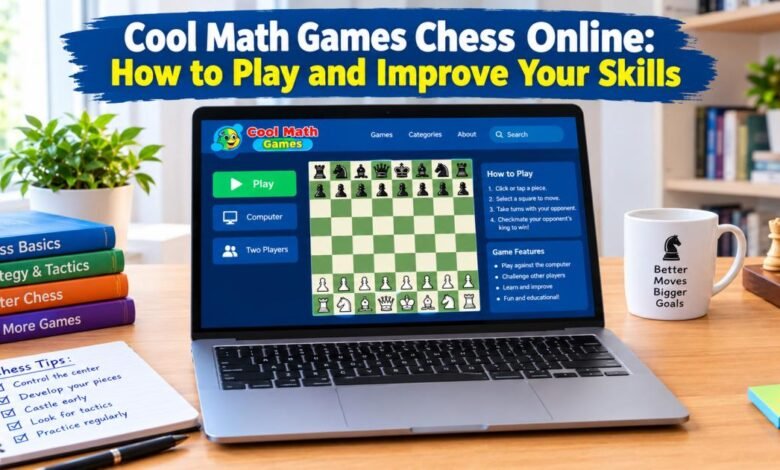
Coolmathgames Chess is a free chess game on Coolmathgames.com that you play right in your browser, with nothing to download. Open the Chess page, click or tap a piece, and choose one of the dots that appear to show where it can legally move. Your goal is checkmate, which means trapping the other player’s king so it can’t escape capture. You can play against the computer, a friend, or an online opponent.
Getting better comes down to a few habits. Take the center, bring out your knights and bishops, castle early, check what your opponent is threatening before every move, and review your games afterward. This guide shows how to practice each habit inside the game, and which mistakes cost beginners the most games. The details below match the Chess page as checked in October 2026, so if something looks different in the game menu, trust the menu.
What Is Cool Math Games Chess?
Cool Math Games is a browser game site that has been online since 1997. It built its reputation on puzzle, logic, and strategy games that students and casual players can pick up quickly. Chess sits in its Classic section alongside Checkers, Mancala, Backgammon, and other board games, and players have rated it 4.5 out of 5 across more than 2.2 million votes. Some people search for it as chess cool math games, but it’s the same game.
The game received a big update in 2026, and three changes matter most if you’re learning. It now works on mobile, so you’re not tied to a laptop. A gameplay analysis tool helps you see where your moves went wrong. And the match finder lets you set the time limit and skill level, so you aren’t dropped into games that are too fast or too hard.
It’s worth being clear about what this is not. It isn’t a full chess school with video lessons or thousands of puzzles. What you get is a clean board, simple controls, and enough tools to learn the basics and improve at your own pace. For many new players, that’s exactly the right starting point.
How to Play Cool Math Games Chess Online
You can start a game in under a minute.
- Go to Coolmath Games and open the Chess page. You’ll find it in the Classic category, or you can search for “Chess.”
- Choose how you want to play: against the computer, against a friend, or in an online match with another player.
- If you pick an online match, set the time limit and skill level. Beginners usually do better with longer games and lower-rated opponents.
- Select a piece. On a computer, click it; on a phone, tap it. Dots will show every legal move.
- Click or tap a dot to move. Keep going until one king is checkmated or the game ends in a draw.
If you’re new, those dots are your safety net. They stop you from making illegal moves while you’re still learning how each piece works. As a quick refresher, pawns move forward one square (two on their first move) and capture diagonally. Rooks slide in straight lines, bishops slide diagonally, and the queen does both. Knights jump in an L shape and are the only pieces that can hop over others. The king steps one square at a time and can never move into check.
A word about “unblocked” versions. Plenty of people search for cool math games chess unblocked or cool math games chess unblocked free because a school or office network filters the site. The official game is already free, so you don’t need a special version. If your network blocks it, that’s a decision made by whoever runs the network, and the right move is to ask them or play at home. Be careful with random sites that advertise unblocked mirrors. They tend to be packed with ads, may not carry the current game, and can be unsafe.
Since it costs nothing, ads do run alongside the game. Coolmath offers an optional paid subscription that removes them, but you don’t need it to play cool math games chess free of charge.
Cool Math Games Chess: Features That Help You Improve
A few features do more for your learning than they first appear to.
The legal move dots teach piece movement faster than a page of rules. Over time you’ll start seeing the available squares before the dots even show up.
Playing the computer gives you a low-pressure place to try openings, test ideas, and make mistakes with no audience and no rating on the line. That freedom is valuable when you’re learning.
The match finder lets you choose a time limit and a skill level, so you can find games that fit where you are right now. Longer time limits give you room to think, and thinking matters far more than speed at the start.
Gameplay analysis is probably the most useful tool in the game. Winning or losing tells you very little by itself. Seeing the exact move where a game turned tells you what to fix.
Mobile play helps too. Short sessions add up, and a game or two on your phone during a break is worth more than one long session a month.
The page also includes a short tips section that covers ideas like castling early, promoting pawns, and sacrificing a small piece to save a bigger one. It’s a handy reminder to read before you start.
How to Improve Your Skills in Cool Math Games Chess
Players often search for cool math games chess hacks, hoping for a trick or a cheat code. There isn’t one, and using outside help against real opponents wouldn’t be fair anyway. The real hacks are habits. The eight ideas below are the ones that lift a beginner’s results fastest, and you can practice every one of them in the game as it stands today.
Control the Center of the Board
The four middle squares (d4, e4, d5, and e5) are the most valuable on the board. Pieces placed there reach more squares and can swing to either side quickly. A knight in the center can reach up to eight squares, while a knight in the corner reaches only two. Opening with a center pawn, such as e4 or d4, claims space and gives your bishop and queen room to move. You don’t have to sit pieces on those squares either. Attacking them counts as control too.
Develop Your Knights and Bishops Early
Development means getting your pieces off their starting squares and into the game. A good opening spends most of its moves on this. Bring out a knight or bishop on each turn, and avoid moving the same piece twice without a clear reason. Knights usually come out first, aimed at the center, followed by bishops on open diagonals. Edge pawn moves and early rook moves rarely help. The player who finishes development first often gets the first real chance to attack.
Protect Your King by Castling
Castling moves your king two squares toward a rook, then places that rook on the other side of the king. It does two jobs in a single move: it tucks the king behind a wall of pawns and brings a rook toward the action. You can castle only if neither piece has moved, the squares between them are empty, and the king isn’t in check or passing through a square under attack. Aim to castle within your first ten moves. A king stuck in the middle of the board is a favorite target.
Recognize Threats Before Making a Move
Before every move, look at what your opponent just did. Ask what the moved piece now attacks and what it has uncovered. Then check whether any of your pieces are undefended. A piece that is attacked and has no protector is called hanging, and it’s the most common way beginners lose material. The habit feels slow at first, but it’s the single best way to stop giving pieces away.
Learn Basic Chess Tactics, Including Forks, Pins, and Skewers
Tactics are short combinations that win material. A fork is one piece attacking two targets at once, and knights are especially good at it because their jumps are hard to see coming. A pin freezes a piece because moving it would expose something more valuable behind it, like a bishop pinning a knight to the king. A skewer is the reverse: you attack a valuable piece, it has to move, and you capture whatever was standing behind it. Learn to spot these for yourself first, then watch for your opponent setting them up against you.
Trade Pieces Wisely and Understand Their Values
Chess players use a simple point system. A pawn is worth 1, a knight or bishop 3, a rook 5, and a queen 9. These numbers aren’t official rules, only a guide for judging trades. Swapping a knight for a bishop is fair. Giving up a rook for a knight loses ground. When you’re ahead in material, trades usually help you, because fewer pieces mean fewer surprises. When you’re behind, avoid them. Keep in mind that position matters too, so a strong attack can sometimes justify a sacrifice.
Practice Checkmate Patterns and Endgame Techniques
Many games are decided by a handful of recurring patterns. The back-rank mate is the most common: a rook or queen checks the king along the first row while the king’s own pawns block its escape. Knowing it helps you deliver it and avoid it, by giving your king a flight square early. Also learn how to checkmate with a king and queen against a lone king, and with two rooks. In the endgame the king becomes an active fighter, and passed pawns, the ones with no enemy pawns in their way, can be pushed toward promotion. Watch for stalemate too. If the opponent has no legal move but isn’t in check, the game is a draw, not a win.
Review Your Mistakes After Every Game
Use the gameplay analysis after each game, win or lose. Look for the first move where the position changed, not just the last blunder. Then write down one lesson in plain words, such as “I moved my queen out too early” or “I forgot to check what that knight attacked.” One honest lesson per game beats skimming a long list of errors you’ll forget by tomorrow.
Common Mistakes to Avoid When Playing Cool Math Games Chess
Certain errors show up in beginner games again and again, and most are easy to fix once you can name them.
The first is bringing the queen out too early. She’s your strongest piece, so it feels natural to use her right away, but she becomes a target and you end up spending moves running from attacks. A classic example is scholar’s mate, a four-move trap in which an early queen and bishop aim at the pawn next to the opponent’s king. It beats players who don’t defend that pawn, and it fails against anyone who does, leaving the attacker with a badly placed queen.
The second is leaving pieces undefended. If a piece has no protector and gets attacked, you lose it for nothing. The third is ignoring your opponent’s last move. Many blunders happen because a player was busy with their own plan and never noticed the threat.
Other common slips include chasing pawns while your pieces sit at home, forgetting to castle, and playing too fast. Fast play is tempting in timed games, so choose a time limit that gives you room to think. On a phone, one more small habit helps: double-check the destination square before you tap, since small screens make mis-taps easy.
Beginner-Friendly Strategies for Winning More Chess Games
Winning more games at the beginner level mostly means two things: not giving pieces away, and taking what your opponent gives you.
Follow the Three Basic Opening Principles
Control the center, develop your pieces, and castle. A simple setup for White is to play e4, bring out a knight to f3, bring out a bishop to c4, and then castle. As Black, answer e4 with e5 and develop the same way. You don’t need to memorize long opening lines. Follow the three principles and adjust to what your opponent does.
Look for Checks, Captures, and Threats
Before each move, scan for three things on both sides of the board: checks, captures, and threats. Going in that order forces you to notice forcing moves first, which are the ones that change a game fastest. Very often your best move, or your opponent’s best reply, is hiding in that short list.
Think One or Two Moves Ahead
You don’t need to calculate ten moves deep. Try a simple question instead: if I play this, what is their best reply, and what will I do then? Looking two moves ahead catches most beginner blunders. As you improve, the depth will grow on its own.
Recognize Opportunities to Win Material
Look for undefended pieces, pieces attacked more times than they’re defended, and chances for forks. Also watch for trades that leave your opponent’s king exposed. Before you grab a free piece, ask yourself why it’s free. Sometimes it’s bait.
Convert an Advantage Into Checkmate
Being ahead isn’t the same as winning. When you’re up material, trade pieces, keep your king safe, and push a pawn toward promotion. Bring your king into the game once the queens are off. Then use the checkmate patterns you’ve practiced, and take care not to stumble into stalemate. A calm, safe move that keeps your lead beats a flashy attack that gives it back.
How to Practice Chess and Improve Consistently
Chess rewards steady effort over long, occasional marathons. The following approach keeps practice simple and repeatable.
Start With Manageable Opponents
Beating slightly weaker opponents builds confidence and shows you what a winning plan feels like. Once you win comfortably several times in a row, use the match finder to move up a level. Losing every game, on the other hand, teaches you very little.
Set Small Goals for Each Game
Pick one target before you start. It might be castling before move ten, never leaving a piece hanging, or trading pieces when you’re ahead. Judge the game by whether you met the goal, not only by the result. Small goals turn every game into practice.
Practice Tactical Puzzles and Checkmate Exercises
Coolmath has several chess-style games that work as puzzles. Checkmate is a cool math games chess puzzle where you find how to mate within a set number of moves, with hints you can buy using coins you earn. Chessformer and King Court Chess turn chess piece movement into puzzles, which strengthens your feel for how each piece travels. They make a good warm-up. When you outgrow them, free sites such as Lichess offer large puzzle libraries. Even ten minutes of puzzles a day sharpens the pattern spotting that wins real games.
Keep Track of Recurring Mistakes
Keep a short note on your phone or in a notebook. After a few games, patterns appear: hanging pieces, forgotten castling, missed forks. That list tells you exactly what to practice next, which is far more useful than guessing.
Build a Simple Daily Chess Practice Routine
A routine can be as short as 20 to 30 minutes. Spend ten minutes on puzzles, play one unhurried game, and use the last few minutes to review it with the gameplay analysis. Fifteen focused minutes every day beat one three-hour session on the weekend. If you’re tired, take the day off, because tired play builds bad habits.
Is Cool Math Games Chess Good for Beginners?
Yes, with a couple of honest caveats. The strengths are clear. The controls are simple, the legal-move dots prevent illegal moves, there’s nothing to download, and an account looks optional, since login is offered mainly for saving favorites and XP. You can also choose opponents by skill level and time limit, and the gameplay analysis gives you feedback that many casual chess games don’t.
The limits are just as real. The free version shows ads, and the game doesn’t teach through structured lessons. Once you know the rules and want a deeper curriculum, a dedicated chess site will serve you better. Coolmath also has a how-to-play chess guide on its blog, which is worth reading before your first game.
If you like cool math games chess and checkers both, the site pairs them well. Checkers is a gentler step that teaches forced captures and thinking one move ahead, skills that carry straight into chess. Many players move between the two, and the site keeps them one click apart.
FAQs
Is Cool Math Games Chess Free to Play?
Yes. You can play in your browser at no cost, and you don’t need to download anything. The site shows ads to cover its costs and sells an optional ad-free subscription for people who want fewer interruptions.
How Do You Play Cool Math Games Chess Online?
Open the Chess page on Coolmath Games and choose your opponent: the computer, a friend, or an online match. If you pick an online match, set your time limit and skill level. Click or tap a piece, then pick one of the dots to move. You win by checkmating the other king.
Can You Play Cool Math Games Chess on Your Phone?
Yes. The 2026 update added mobile play, and the game page lists both browser and mobile as supported platforms. Tap a piece, then tap its destination square. Because phone screens are small, check the square before you tap.
Can You Play Cool Math Games Chess Against Friends?
Yes. Besides the computer and online opponents, the game lists challenging a friend as an option. Menu options can change, so look in the game itself for the current way to set up a match with someone you know.
How Can You Win More Games on Cool Math Games Chess?
Mostly by losing fewer pieces. Check what your opponent is threatening before each move, control the center, bring out your knights and bishops, castle early, and trade pieces when you’re ahead. Afterward, use the gameplay analysis to find the move where the game turned.
Does Cool Math Games Chess Have Different Difficulty Levels?
The match finder lets you adjust skill level and time limit, so you can pick opponents that suit you. Whether the computer opponent offers fixed levels is something to confirm in the game menu, since options can change. If you’re new, start low and move up as you win.
What Is the Best First Move in Chess for Beginners?
Most coaches suggest pawn to e4 or pawn to d4. Both claim the center and open lines for your queen and bishop. If you’re playing White, e4 is the simplest choice, and you can follow it with a knight to f3, a bishop to c4, and castling.
Start Playing Cool Math Games Chess and Improve Your Strategy
Cool Math Games Chess is an easy place to begin. It’s free, it runs on a computer or a phone, and its move dots, match finder, and gameplay analysis remove much of the confusion that makes early games frustrating. Start with the basics: take the center, develop your pieces, castle, and check for threats before every move. Play a few games each week, review them, and carry one lesson into the next game. If you enjoy it, branch out to the puzzle games and Checkers on the same site, and later to dedicated chess sites for deeper training. Open the game, make your first move, and see how far a few good habits can take you.