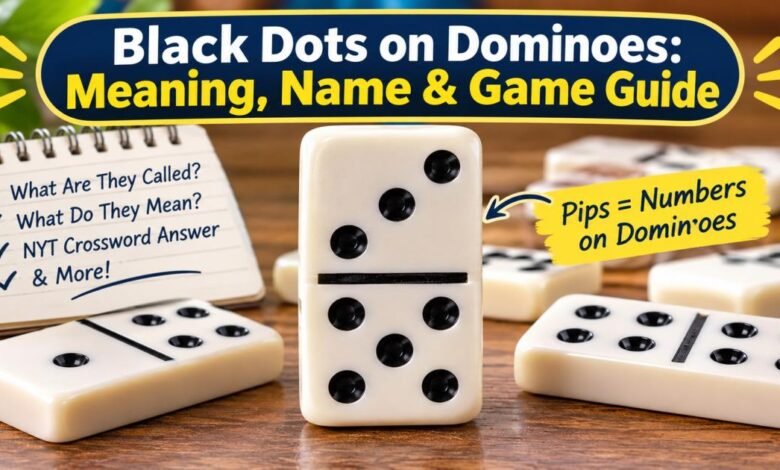
The black dots on dominoes are called pips, though casual players also refer to them as spots. Each dot represents one numerical point, ranging from zero on a blank end up to six, nine, twelve, or eighteen, depending on the game set. If you are solving a daily puzzle and need the black dots on dominoes NYT clue, the four-letter answer is PIPS.
Understanding how these markings work makes every domino game easier to play, count, and score. Across family tables, neighborhood domino clubs, and competitive tournaments, players rely on a single consistent visual system—symmetry—to read tiles quickly from any seat. Below, you will find the history behind the dots, how symmetrical tile patterns guide gameplay, set totals, and answers to the most common crossword clues.
What Are the Black Dots on Dominoes Called?
When people ask what the black dots on dominoes are called, game makers, tournament officials, and dictionary editors all use the official term pips. Every individual dot pressed or painted onto the face of a domino tile counts as one pip.
The Meaning of Pips
In tabletop games, a “pip” is any small, countable mark that shows numerical value on a game piece. English speakers have used the word since the late 1500s to describe the symbols on playing cards, dice, and dominoes. Instead of printing digits like “4” or “6” onto small bone or ivory tiles, early craftspeople drilled tiny circular pits and filled them with dark ink so players could read them cleanly across a table.
Why Domino Dots Are Also Called Spots
In casual games across the United States and around the world, players frequently call pips spots. Both words describe the exact same markings. Tournament rulebooks and crossword puzzles prefer “pips,” while everyday players often say “spots” because dark circles stand out sharply against light-colored tiles.
What Numbers Do the Dots Represent?
Each pip holds a value of 1. Dominoes use a direct one-to-one counting system rather than assigning different point values to different shapes. If one half of a tile shows five dots, that end equals five. Because manufacturers arrange the dots in fixed symmetrical layouts, experienced players recognize each number at a glance without counting individual dots.
What Do the Black Dots on Dominoes Mean?
Learning what the black dots on dominoes are goes beyond vocabulary—those markings govern every legal move and every point scored during a match.
How Each Dot Represents a Number
Dominoes originated in China during the Song Dynasty before reaching Europe in the 1700s. Early artisans modeled the tiles after the outcomes of rolling two six-sided dice. Because a standard die displays numbers from one to six, traditional domino halves feature between one and six pips, with each dot representing a single point.
Understanding Blank Sides and Zero
Not every domino end carries dots. Many tiles have one or two smooth, unmarked halves called blanks. A blank end represents zero. Even with zero pips, a blank remains an active suit on the board. Players match a blank end to another blank end just as they match two fours or two sixes.
How Both Sides Determine a Domino’s Value
A center line or metal spinner pin divides every domino into two halves. You find a tile’s total point value by adding the pips on both ends together:
- The 6-4 Tile: Six pips on one end plus four pips on the other equal 10 points.
- The 3-0 (Three-Blank) Tile: Three pips on one end plus zero on the blank end equal 3 points.
- The Double-Blank (0-0) Tile: Zero pips on both ends equal 0 points.
Understanding Domino Pip Patterns
Standard domino sets arrange dots in uniform, symmetrical patterns so your eyes process a tile’s value in a fraction of a second.
One Pip: The Number One
A single dot sits dead center in the middle of the tile half. Many manufacturers make the center dot slightly larger than standard pips so a single-pip end stands out clearly.
Two Pips: The Number Two
Two dots sit diagonally across from one another, running from one corner toward the opposite corner.
Three Pips: The Number Three
Three dots form a straight diagonal line stretching from one corner through the center to the opposite corner.
Four Pips: The Number Four
Four dots sit near the four corners of the tile half, forming a balanced square.
Five Pips: The Number Five
Five dots combine the four-corner square with a fifth dot placed in the exact center, forming an “X” shape.
Six Pips: The Number Six
Six dots line up in two parallel columns of three dots each along the outer edges, leaving a narrow open space down the middle.
How Larger Domino Sets Use More Pips
While classic sets stop at six pips per end, expanded sets reach 9, 12, 15, or 18 pips on a single half. To fit higher counts onto a standard-sized tile, makers shrink the dot diameter and arrange the pips in tight grids of three or four columns, often using distinct colors so players separate a 9 from a 12 immediately.
Why Do Dominoes Have Black Dots?
Dark dots on a bright tile face solve several practical challenges during live play.
Making Numbers Easy to Recognize
Strong contrast between black pips and an ivory or white background prevents eye fatigue during long matches. Because a domino chain twists sideways and upside down across the table, symmetrical dot patterns look identical from every direction. Printed digits like “6” and “9” would look identical when flipped upside down, whereas symmetrical dots remove all guesswork.
Helping Players Match Domino Tiles
During fast-moving games like Block, Draw, or Mexican Train, players scan the open ends of the layout and compare them against the tiles in their hand. Visual symmetry lets your brain match geometric shapes rather than reading numbers, keeping turns quick and fluid.
Making Scoring and Counting Easier
At the end of a round, the winner usually collects points equal to the total pips left in their opponents’ hands. Grouping leftover tiles into sets of ten dots takes seconds when you pair a 6-pip end with a 4-pip end.
How Do Black Dots Work in a Domino Game?
If you are learning dominoes for the first time, understanding how pips interact on the table explains nearly every rule variation.
Understanding the Two Halves of a Domino Tile
Each domino functions as two separate numbers joined together. While holding a tile, you can play either half onto the board as long as that end matches an open number on the table.
How to Match Tiles by Their Pip Counts
To make a legal move, the pips on one end of your tile must match the pips on an open end of the domino layout. For example, if an open end shows four pips, you can connect any tile from your hand that displays a four on either half—such as a 4-1, 4-6, or 4-0.
What Are Double Dominoes?
A double displays the exact same number of pips on both halves, such as 1-1, 4-4, or 6-6. In nearly all domino games, players place doubles perpendicular (crosswise) to the main line of tiles. Depending on the game variation, the first double played often acts as a “spinner,” allowing players to branch off in four directions instead of two.
How Pip Counts Affect Game Scoring
Pips determine the score in two primary ways depending on the rules you play:
- End-of-Round Penalty Points (Draw & Block Dominoes): When one player empties their hand (“dominoes”), they score the combined sum of all pips remaining in their opponents’ hands. Holding heavy tiles like the 6-5 or 6-6 late in a hand puts you at risk of giving away 11 or 12 points in a single turn.
- In-Game Scoring Multiples (All Fives / Muggins): Players score points immediately during their turn whenever the pips on all open ends of the board add up to a multiple of five (5, 10, 15, 20, or higher).
How Many Dots Are on a Standard Domino Set?
Manufacturers name domino sets after their highest double tile. The standard box sold in most stores worldwide is the Double-Six set.
How Many Tiles Are in a Double-Six Set?
A standard Double-Six set holds 28 unique tiles. Every possible pairing of numbers from 0 (blank) through 6 appears once in the box with no duplicates.
Total Number of Pips in a Double-Six Set
If you count every black dot across all 28 tiles in a Double-Six set, you reach 168 pips in total. Each number from 0 to 6 appears eight times across the full set—six times paired with other numbers, plus twice on its own double tile. Multiplying those eight appearances by the sum of 0 through 6 (821) equals exactly 168.
Differences Between Double-Six, Double-Nine, and Double-Twelve Sets
Larger groups of players need bigger sets so everyone draws a full starting hand. Here is how the three most common sets compare:
| Set Type | Highest Tile | Total Tiles | Total Pips | Recommended Players |
| Double-Six | 6-6 | 28 tiles | 168 pips | 2 to 4 players |
| Double-Nine | 9-9 | 55 tiles | 495 pips | 4 to 6 players |
| Double-Twelve | 12-12 | 91 tiles | 1,092 pips | 6 to 8+ players |
Black Dots on Dominoes NYT: Crossword Answer Explained
Many readers search for this phrase while finishing a morning word puzzle. If you hit the black dots on dominoes NYT crossword clue, you need a short, familiar gaming word.
What Is the Answer to the Black Dots on Dominoes NYT Clue?
The answer to the black dots on dominoes NYT clue is PIPS.
Why Is PIPS the Correct Four-Letter Answer?
Crossword editors rely on PIPS because it combines high-frequency letters (P, I, S) with a reversible pattern that fits cleanly into tight grid corners. Clue writers rotate similar prompts—such as “Black dots on dominoes,” “Spots on dice,” or “Playing card symbols”—to test knowledge of classic tabletop terms.
Black Dots on Dominoes NYT Mini Crossword Answer
When the black dots on dominoes NYT Mini clue appears in the smaller daily puzzle, the four-letter answer is also PIPS. Because the NYT Mini runs on a compact 5×5 grid, four-letter words with common vowels and consonants appear regularly.
When Did This NYT Mini Crossword Clue Appear?
The “Black dots on dominoes” clue has appeared in The New York Times Mini Crossword multiple times—including editions in September 2023 and October 2024—and regularly returns to both the Mini and the full-sized daily crossword archives.
Are Domino Pips the Same as Dots on Dice?
Dominoes and six-sided dice share a direct historical connection, which explains why their faces match so closely.
Similarities Between Domino Pips and Dice Pips
Both dominoes and standard dice use circular dots arranged in the exact same symmetrical layouts for numbers one through six. Early Chinese domino sets represented all 21 possible outcomes of throwing two six-sided dice, while European makers later added seven blank-half tiles to represent zero.
Differences in Their Number Patterns
While numbers 1 through 6 share identical geometry on both dice and dominoes, dominoes extend well past six. A standard die stops at six faces, whereas larger domino sets continue up to 9, 12, 15, or 18 pips per side. Dominoes also feature blank ends for zero, which do not exist on traditional number dice.
Why Both Use the Term Pips
Both games share the word pips because English applies the term to any counting dot or suit symbol printed on tabletop gaming pieces—including dice, dominoes, and playing cards.
Common Misconceptions About Domino Dots
Even longtime players occasionally repeat a few myths about how domino dots work.
Are All Domino Dots Black?
No. While classic sets feature black dots on white tiles, modern sets frequently use colored pips—especially in Double-Nine, Double-Twelve, and Double-Fifteen boxes. Makers assign a specific color to each number (such as red for 6, green for 5, and blue for 4) so players identify high-value tiles quickly during games like Mexican Train or Chicken Foot.
Do Blank Domino Sides Have a Value?
Yes—a blank half carries a numerical value of zero. Some beginners assume a blank tile acts as a “wild card” that connects to any number. Under official rules, a blank counts strictly as zero and only connects to another blank end.
Are Pips and Spots Different Things?
No, the two words mean the exact same thing. “Pips” is the formal dictionary and tournament term, while “spots” is the casual everyday name.
Do More Dots Always Mean a Better Tile?
Not always. High-pip tiles like the 6-6 or 6-5 help early in a round when you hold plenty of matching options, or in games like All Fives where big totals hit scoring multiples. In Draw or Block dominoes, however, getting caught with high-pip tiles at the end of a round hands extra penalty points directly to your opponent.
Final Thoughts on the Black Dots on Dominoes
Whether you call them pips or spots, those simple dots anchor every domino game played around the world. Their symmetrical layouts let players of any age or language match tiles, tally scores, and plan strategy in seconds—while giving puzzle fans a reliable four-letter answer whenever PIPS shows up in the daily crossword.
Frequently Asked Questions About Black Dots on Dominoes
What Are the Black Dots on Dominoes Called?
The black dots on dominoes are officially called pips. Each individual dot represents one point of numerical value on that half of the tile.
What Is Another Name for Domino Dots?
Another common name for domino dots is spots. Both “pips” and “spots” refer to the exact same circular markings on a domino tile.
What Does PIPS Mean in Dominoes?
In dominoes, pips refers to the small circular dots recessed or printed onto the face of a tile to indicate its numerical value. Every single pip equals a count of 1.
How Many Pips Can a Domino Have?
In a standard Double-Six set, one half of a tile holds between 0 (blank) and 6 pips, giving a single tile a maximum total of 12 pips (on the 6-6 double). In larger specialty sets like a Double-Twelve or Double-Eighteen set, a single tile can hold up to 24 or 36 total pips.
Why Are Domino Dots Arranged Like Dice?
Dominoes originated as a physical representation of all possible outcomes from throwing two six-sided dice. Because of that shared history, domino halves for numbers one through six use the exact same symmetrical dot layouts found on standard dice.